
One Hotel or Two in London? The One Change Decision Guide
If you are planning a 5 to 7 night London stay, the real question is usually not can I split my stay. It is should I. One hotel is simpler. But one well-timed change can sometimes give you a better total, better availability, or a cleaner shape to the week without turning the trip into hard work. If you are new to the idea, see our Split-Stay 101 London guide.
This guide is here to help you make that call properly. Not every trip should be split. In plenty of cases, one hotel is clearly the right answer. But if your dates touch a weekend spike, a sold-out patch, or two different parts of London that you actually want to use, a split stay (2 hotels) can be worth testing. Hotel Splitter is designed to make this comparison easier by letting you compare one hotel stays and split stays (2 hotels) in London on the same dates with one total package price. By the end, you should know which side of that line your trip sits on. For context, VisitBritain and UK Parliament analysis note that the average inbound trip is around 7.4 nights and London accounts for a large share of UK overnights, so a week-long stay is typical.
Quick answer
Keep one hotel if you already have a good full-week rate, your dates are not breaking on weekend spikes or event pressure, and you would rather avoid even one switch.
Test a split stay (2 hotels) if one hotel gets awkward on price or availability, if your week touches an expensive Friday or Saturday pattern, or if you want two London areas without making the trip feel fragmented.
The point is not to force a split stay. It is to see whether one manageable switch gives you a better week overall. Search London here and compare one hotel and split stay (2 hotels) options on your dates.
The 5 minute decision guide
Use this matrix to sense check your trip. If you land in the left column more than once, a split stay (2 hotels) is worth testing. If the right column keeps winning, stay with one hotel and keep the trip simple.
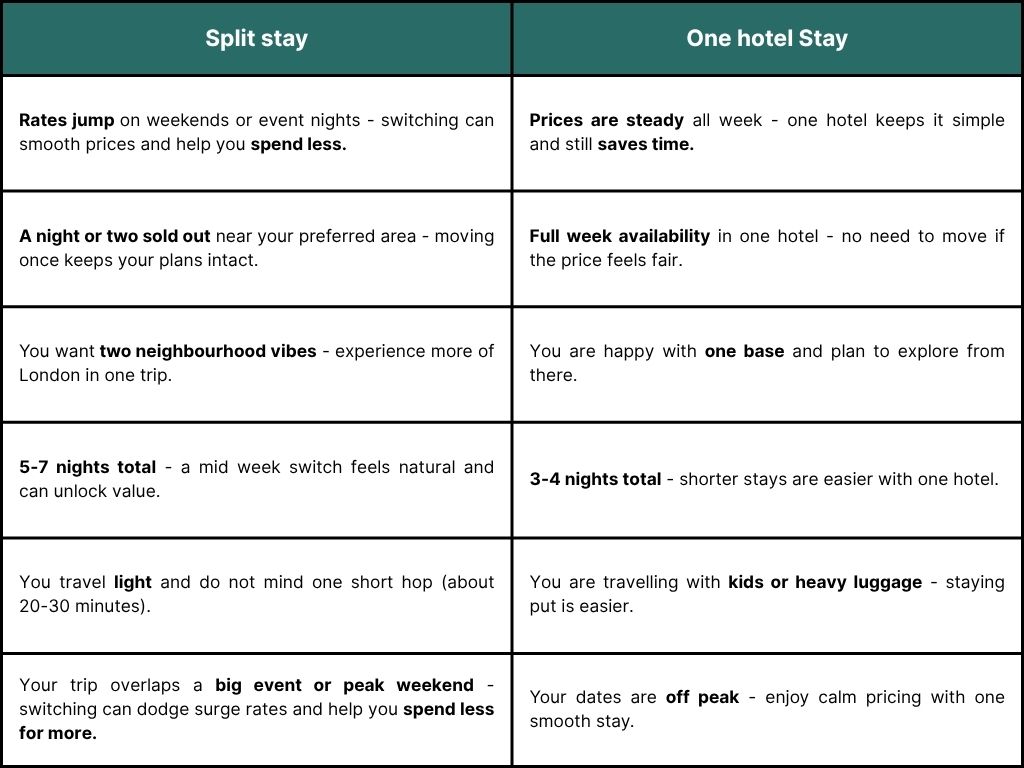
Scenarios where a split stay (2 hotels) can win
Weekend spike or event clash
London pricing follows a clear rhythm. Weekend demand pushes rates higher, and event dates can push them higher again. According to STR Aug 2025, London room rates hit record highs in July 2025 with occupancy at 88.6 percent, the highest since July 2018. If your week touches late June or July peaks, or a Friday or Saturday during a major event, a split stay (2 hotels) can let you place the priciest nights somewhere calmer or handle the expensive night without overpaying across the full week. If you are facing sold out weekends or surging prices, this is one of the clearest use cases.
A split stay (2 hotels) can let you keep the buzz where it matters and ease off where it does not. It can be a cleaner fix than forcing one hotel to carry an awkward week on its own.
Mid-week sell-out near a venue
Big-ticket events do not just raise prices. They can wipe out availability in specific neighbourhoods for part of the week. STR Oct 2025 reported occupancy around the mid-September concert weeks hitting the mid-90s on peak nights, and HospitalityNet highlighted 94.8 percent occupancy on 17 September alongside elevated ADR. Around the London Marathon Reuters, Wimbledon, Frieze, or the NFL London Games, splitting the week can mean staying near the action for the part that matters and somewhere less distorted for the rest.
You are not trying to build a clever itinerary for its own sake. You are solving a broken week with one practical switch.
Two different London modes in one trip
Sometimes the value is not just financial. Three nights in Shoreditch or King’s Cross, then a move to South Kensington or Notting Hill, can give the week a cleaner rhythm than forcing one area to do every job. You explore one side of London properly, then reset once and explore another. If you want pairing ideas, see our Where to stay a week in London guide.
This only works if the handover stays easy. One switch is enough. More than that and the gain usually starts to evaporate.
Late arrival or early departure
If you are landing at Heathrow late or leaving early, a first or last night near the Elizabeth line can make the week easier to shape. TfL quarterly reports and the TfL annual report show the line has carried around 500 million journeys in two and a half years, and TfL step-free access confirms all 41 stations are step-free. It is a smooth, lift-equipped hop between the airport, the West End, the City, and Docklands.
That can make it easier to stay near Paddington or Canary Wharf for the airport-facing night, then move once to the area you actually want for the rest of the trip. The switch can be about 20 to 30 minutes.

Make the one switch feel easy
A split stay (2 hotels) is only worth it if the logistics stay light. Here is how to keep it workable:
- Switch on a day that already has movement in it. Check out in the morning, sightsee, then check in after lunch.
- Pick areas with a clean connection. One line, a short taxi, or an easy Elizabeth line hop beats a technically short but awkward route.
- Travel light enough that the move feels ordinary. One roller bag is very different from a full relocation.
- Keep it to one switch. The value comes from fixing the week once, not from trying to optimise every night.
This middle ground is where a split stay (2 hotels) can often earn its keep: not a fragmented trip, not an all-or-nothing single hotel week, but one manageable switch if it improves the total plan.

When one hotel is the better answer
One hotel is the right call if you have already found a good rate that covers your whole week, your dates avoid obvious pressure points, or you simply do not want the admin of checking out and checking in again. It is also often the better answer for shorter trips, family-heavy trips, or any week where you mainly care about settling in once and staying put.
If your stay is only 3 or 4 nights, the gain from switching can disappear quickly. And if you already have a hotel that is well priced, well located, and available across the full stay, there is no prize for making the plan more complicated. The aim is to improve the week where that helps, not create movement for its own sake.
FAQs
How much time do I lose switching hotels?
Usually about 20 to 30 minutes for the journey, plus check-out and check-in. Most travellers fold it into a sightseeing window and do not feel like they lost half a day.
What if I have luggage?
Store it at your first hotel, spend a few hours out, then collect it and head to the next place. Most London hotels will store luggage around check-out day.
Does this work with flight times?
Yes. If you are landing late or leaving early, you can use an airport-facing night near Heathrow or Paddington, then move once to somewhere more central. The Elizabeth line makes that kind of one-train hop much easier.
Can I actually save money this way?
You can, especially if your dates touch event pressure or an expensive Friday or Saturday pattern. The simplest test is to compare the one hotel option against a split stay (2 hotels) on the same dates and see which total actually comes out better.
What does Hotel Splitter actually do here?
Hotel Splitter compares one hotel and split stay (2 hotels) options for the same stay, then shows the full package total so you can decide whether the switch improves the week enough to justify it.
Do I see one price or two separate prices?
One total package price in £. If you choose a split stay (2 hotels) option, Hotel Splitter shows the combined cost upfront, so you do not need to add segments together yourself.
Is the Tube accessible if I am carrying luggage?
All 41 Elizabeth line stations are step-free, and many of the big interchange stations on other lines have lifts. If you prefer, a short taxi between areas can also keep the move easy.
Ready to test which week works better
If one hotel already gives you the right total and the right week, keep it simple. If it does not, test one clean change rather than forcing the whole stay through a bad rate or a broken availability pattern.
Use Hotel Splitter to compare one hotel and split stay (2 hotels) options on the same dates. If one hotel already wins, keep it. If one switch improves the week, you should be able to see that more clearly.
Last updated: April 2026.