
10 ways to cut London hotel costs this week
If your London hotel total looks wrong, the fastest way to regain control is not to restart your whole plan. It is to run a few small, like-for-like tests and see what is actually driving the cost.
Sometimes the whole week is expensive. Sometimes one Friday, Saturday, or event-heavy night is doing most of the damage.
That is why this page is built as a checklist. Keep the same stay length, change one thing at a time, and stop once you find a version of the week you can live with.
By "this week" we mean the specific week you are pricing for your trip.
VisitEngland reported hotel room occupancy for August 2025 at 81%, with year-to-date occupancy at 78%, which helps explain why some weeks can feel tight when you price a 5 to 7 night stay. August 2025 occupancy
Quick answer
- Start with one total you trust for your exact dates.
- Check whether a bank holiday, major event, or one weekend night is inflating the stay.
- Re-price the same stay length one day earlier and one day later.
- Separate the nights that really need to be near central from the nights that can be more flexible.
- If one hotel is expensive or unavailable for part of the week, compare staying put with a split stay (2 hotels in one trip).
If you want to test one hotel versus one simple switch on the same dates, Hotel Splitter is built for that comparison.
What to do next if London hotels feel too expensive this week
-
Lock your week and constraints first. Decide your stay length, your maximum total, and any dealbreakers such as lift access, air conditioning, or a quieter room.
-
Get one baseline you trust. The CMA says booking sites should show customers the total price up front, so use totals as your baseline rather than teaser nightly rates. Show total price up front
-
Pick your flexibility levers before you search again. Date shift, which nights must be nearer central, and whether one easy switch is acceptable.
-
Work through the 10 actions below in order. Stop after you have tested the two or three actions that actually fit your situation.
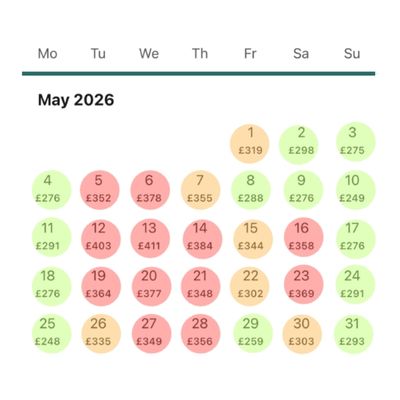
The 10 actions
Action 1: Check bank holidays
Check bank holidays first, because they can change demand patterns for specific nights. The UK government bank holiday calendar is the cleanest first check. UK bank holidays 2026
- Start with your check-in and check-out days.
- Then check the weekend in the middle of your stay.
- If you are flexible, test a nearby week.
Action 2: Check major events
Flag major events that can pack central areas and absorb rooms. Visit London notes that Notting Hill Carnival usually takes place on the last weekend of August, including the summer bank holiday Monday, and that more than 1 million people may attend over the weekend. Notting Hill Carnival crowds
- If your dates overlap a major event, treat those nights as your scarce block.
- Build the rest of the week around the scarce block, not the other way round.
Action 3: Shift dates by 1 day both ways
Shift your week by one day in both directions and re-price the same stay length. VisitEngland reported January 2025 weekend occupancy at 63% and weekday occupancy at 66%, which supports testing different date shapes instead of assuming every week behaves the same way. Weekend vs weekday occupancy
- Keep the stay length identical so it stays like-for-like.
- Run one day earlier and one day later before deciding.
- Keep the best result as your new baseline.
Action 4: Use Flexible Fit as a method
Use Flexible Fit as a method: price the best-looking nights first, then build the rest of the week around them. For the full breakdown, read Flexible Fit: Best-priced nights in London.
- Pick the nights that look workable, then adapt your plan around those.
- Keep it to a 5 to 7 night structure, not nightly reshuffling.
Action 5: Test 2 blocks with 1 move
Test two blocks with one move if one hotel is expensive or unavailable for part of the week. Visit London says left luggage is available at London's main train stations and Victoria Coach Station, and that Excess Baggage Company left luggage at main stations is open daily from 7am to 11pm. Left luggage opening hours
This is the point where a split stay (2 hotels) becomes worth testing. The goal is not hotel hopping. The goal is one manageable switch if it improves the total or solves a broken availability patch.
Use Hotel Splitter to compare one base versus one simple switch for your exact dates in one place.
- Plan one changeover day and keep the rest stable.
- Read how split stays work: London split stays guide.
Action 6: Widen by travel zones
Widen by travel zones, then sanity-check the travel trade-offs. TfL notes that the zones you choose must include all the zones you will travel through, and travelling outside your chosen zones may result in additional charges. TfL fare zones rule
- Think in zones first rather than aiming for a specific neighbourhood.
- Keep typical journeys realistic for your plans.
Action 7: Factor travel costs by time and route
Account for travel costs varying by route and time when you widen the search. TfL notes that fares may vary depending on line used, direction, time of day and day of the week. Fares vary by time
- If you expect to travel at peak times, factor that into the overall cost.
- Use your likely journey times as the test, not ideal scenarios.
Action 8: Treat "from" prices as a lead
Treat "from" prices as a lead, not an answer. The ASA says it applies a rule of thumb that at least 10% should usually be available at the "from" price, and it assesses "from" availability case by case. ASA guidance on "from" prices
- Click through to your exact dates before you trust the headline.
- Compare totals on the same room basis, not a lead-in rate on different terms.
Action 9: Ignore pressure messaging
Ignore pressure messaging and focus on what is truly relevant to your dates. The CMA says popularity and availability statements should not be designed to create an artificial impression of scarcity. Avoid artificial scarcity
- Treat rooms left and people viewing as prompts to double-check, not to rush.
- Decide based on your plan and your total, not countdown cues.
Action 10: Verify discounts are like-for-like
Be cautious with discount framing and keep it like-for-like. The CMA says discounts must be genuine and compare the same room types for the same stay dates. Like-for-like discounts
- Check the room basis and dates match before treating it as meaningful.
- If anything differs, return to totals and re-compare calmly.
Partial availability: what to do if your preferred place is sold out for some nights
If your preferred option is available for only part of the week, treat it as two blocks: the nights you want most, then the remaining nights. VisitEngland notes that committed occupancy rates rise as the months progress and more bookings are made, which helps explain why gaps can appear as your dates get closer. Bookings rise over time
If the sold-out nights are concentrated around the weekend, a simple reference example is in London hotels sold out at the weekend: what to do next.
When one hotel is the better choice
Sometimes paying more for one base is the right trade-off, especially if you want the same routine every day or you do not want any changeover friction. A simple way to weigh it is to compare how much the move buys you against how much simplicity matters to you.
If you want a structured decision guide, read Cheaper to move hotels or stay all week in London? For context on why some weeks spike, read Why are London hotels so expensive this week? For pricing basics, see London hotel pricing and availability.
FAQs
What does "this week" mean in practice?
It means the specific week you are pricing for your trip. The actions above work best when you keep the stay length the same and test one change at a time.
What should I test first if one London hotel night is much more expensive than the others?
First check whether a bank holiday, major event, Friday or Saturday is driving the spike. Then test the same stay one day earlier and one day later. If only one part of the week is broken, compare staying put with one simple switch.
How do I compare options fairly when I am short on time?
Start with totals, not teaser nightly rates. The CMA says booking sites should show customers the total price up front to avoid hidden charges. Show total price up front
How do I avoid being misled by "from" prices?
Verify the price for your exact dates and compare like-for-like totals. The ASA says it applies a rule of thumb around "from" price availability and assesses "from" availability case by case. Significant proportion availability
Does staying further out always cost less overall?
Not always, because travel costs and convenience matter too. TfL notes that travelling outside your chosen zones may result in additional charges. Travelling outside zones
If I switch hotels once, do I have to carry luggage all day?
Often you can store bags at your hotel and carry on with your plans. Visit London also notes that you can find left luggage facilities at London's main train stations and Victoria Coach Station, and that luggage can be stored from a few hours to several days depending on the facility. Store luggage for days
What if a site makes it feel like I must book immediately?
Focus on what you can verify for your dates. The CMA says popularity and availability statements should not be designed to create an artificial impression of scarcity. Avoid artificial scarcity
Check your dates
Check your dates and compare one base versus one simple switch for the week you are pricing. For deeper reading, see Save money on London hotels for a week and London hotel pricing and availability.
Next reads
- Save money on London hotels for a week
- London hotel pricing and availability
- Why are London hotels so expensive this week?
- Flexible Fit: Best-priced nights in London
- Cheaper to move hotels or stay all week in London?
Last updated: April 2026.