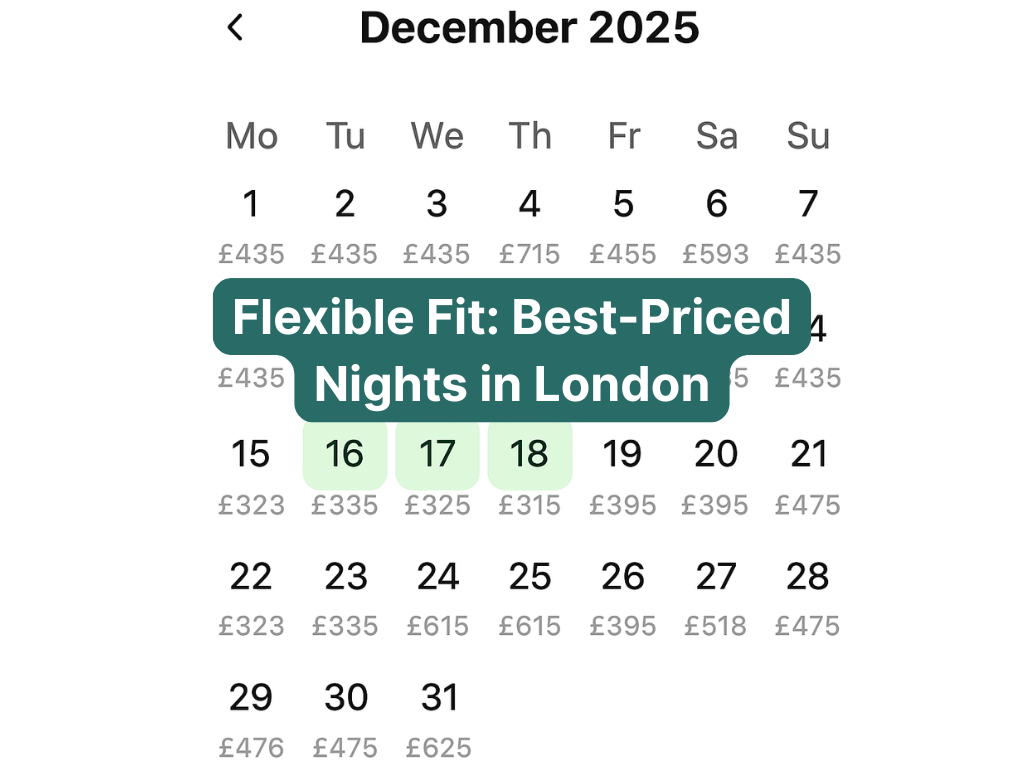
Flexible Fit: Best-Priced Nights in London
London doesn’t price itself in tidy week-long blocks. Room rates move with weekdays, weekends, events and school holidays, so the “perfect” seven-night stay at one 4★ hotel is often either expensive, sold out, or broken by one awkward night in the middle.
That’s where a flexible fit helps. Instead of forcing every night into a single hotel, you can treat London as a week-long puzzle: one 5–7-night trip across two nearby areas, one midweek switch, and one total package price in £. You still sleep in 4★ comfort, just with more options to fit the calendar.
This guide explains why full-week prices rarely align, how to plan around spikes and calmer weeks, and how a single midweek change keeps everything feeling simple, not stressful.
TL;DR: London’s best-priced nights rarely line up for a full week at one 4★ hotel. Weekday, weekend and event spikes mean single-hotel weeks often clash with price and availability. A flexible fit – one 5–7-night trip, one midweek switch between two nearby areas, one total package price in £ – lets you work around busy nights instead of paying through them.
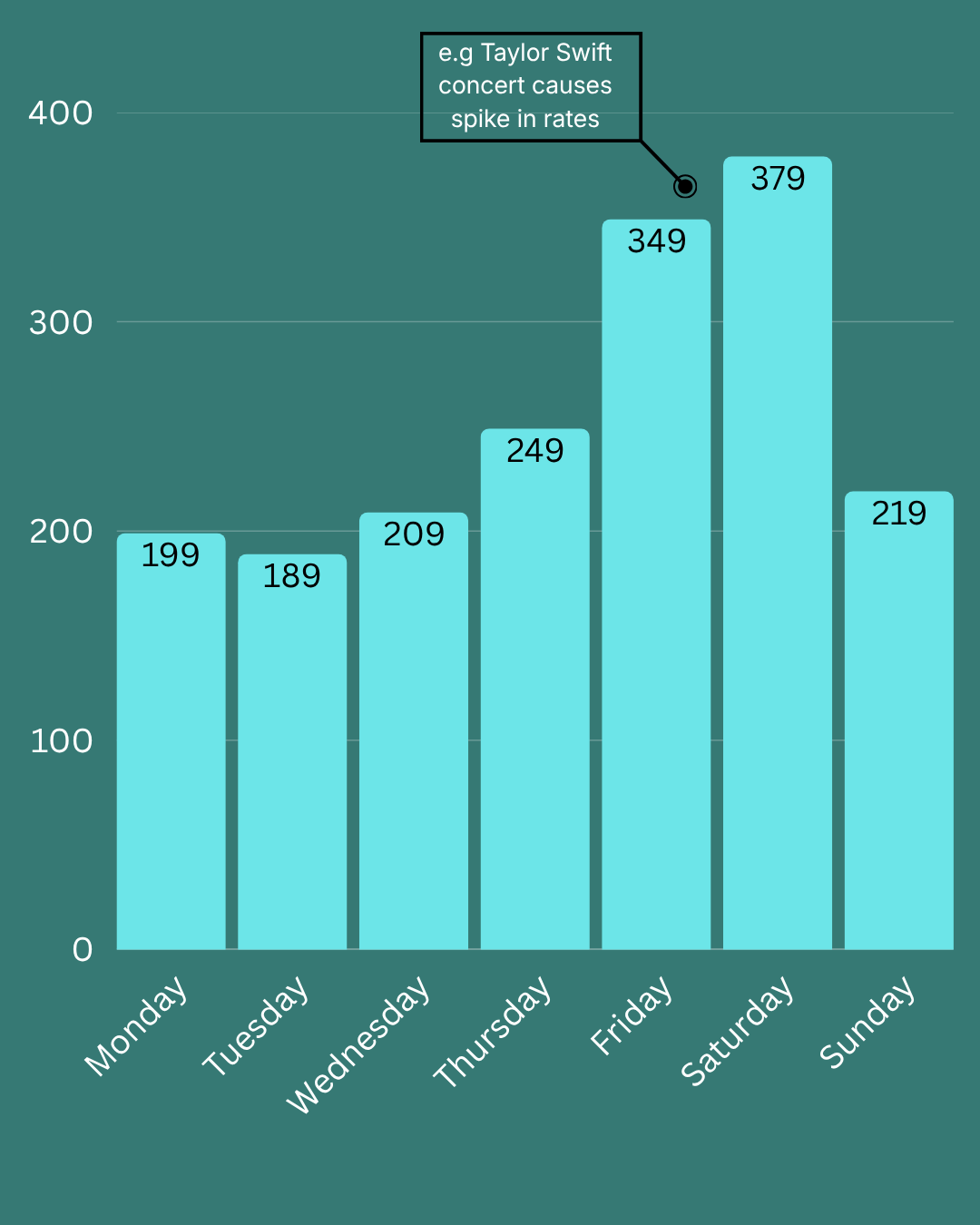
Why full-week single stays often clash with price
London’s hotel market doesn’t move in straight lines. It jumps. STR’s July 2025 record highs showed how Wimbledon and the Oasis tour pushed average daily rates and RevPAR to new records, with July occupancy around 88.6% and many Wimbledon nights over 90%. That pressure doesn’t stop at one postcode – it ripples across central London.
On top of that, trading updates from major chains show an uneven weekly rhythm. Whitbread commentary reported that midweek business and peak leisure demand remained robust, while short-lead weekend demand was slightly softer, particularly in London. In other words, the “expensive” nights in one area aren’t always Friday and Saturday – they might be Tuesday and Wednesday when corporate demand peaks.
Zoom out further and the typical London stay has lengthened. VisitBritain’s inbound data put the average visit at around 6.9 nights in 2024, which lines up almost perfectly with a 5–7-night city break. The catch is that trying to pin all those nights to one 4★ hotel often means paying a premium for a couple of misaligned dates – or finding that the one hotel you like is missing exactly the nights you need.
Instead of fighting that pattern, a flexible fit accepts it. You still book a week in London, but you let the shape of the week – midweek demand, weekend softness, event spikes – influence where you sleep, rather than insisting on a single option at all costs.
Plan around spikes, holidays and calmer weeks
Some dates are almost guaranteed to make a clean, single-hotel week difficult. Bank holidays, school holidays and big events pull demand into certain stretches of the calendar, then leave calmer weeks either side.
For 2026, England and Wales bank holidays such as Good Friday (3 Apr), Early May (4 May) and the Summer bank holiday (31 Aug) create long weekends when domestic travel and city hotel demand tighten. London school term dates add more texture: many borough calendars show a half-term break from 16–20 Feb 2026, creating a family-peak week inside an otherwise steady term.
Layer on the headline events and the picture sharpens. The London Marathon 2026 is scheduled for Sunday 26 Apr 2026, with runners, supporters and volunteers turning that whole weekend into a long, busy block. Wimbledon’s 2026 dates run from 29 Jun–12 Jul, pulling two full weeks of demand into SW London and central hubs.
This doesn’t mean you should avoid these weeks altogether – they can be brilliant times to visit. It does mean you should think about how your seven nights overlap them. Arriving the Sunday after the Marathon, or leaving the Thursday before Wimbledon’s first weekend, often lands you in calmer territory while still enjoying the city at its best.
Flexible-fit planning looks at your week like this:
- Circle obvious peaks – bank holidays, half-terms, Marathon, Wimbledon.
- Look at the seven-night window you want, and note which nights will feel busiest or priciest.
- Use those nights to decide when a midweek switch helps you work around pressure, instead of absorbing it.
Make one midweek switch feel easy
The idea of changing hotels once midweek can sound like hassle – until you look at how connected central London has become. The Elizabeth line, in particular, has made cross-city hops quicker and more accessible than they used to be.
TfL’s guidance on the Elizabeth line to Heathrow notes that journeys between Paddington and the airport take about 28 minutes, with all 41 stations on the line step-free from street to platform. That same infrastructure makes moving between central areas quicker too. Typical off-peak journeys between central stations – think Liverpool Street to Paddington, Farringdon to Canary Wharf via interchanges, or Tottenham Court Road to Stratford – often fall into a 15–25-minute band. For precise timings, it’s always worth checking the TfL Journey Planner.
On the ground, that means a midweek switch is less “cross-city trek” and more “short hop with a coffee stop”. You check out late morning, travel for 20 minutes or so on a step-free route, drop bags at the next 4★ hotel, and get back to exploring. When you approach it like that, the effort of one move is small compared with the benefit of fitting your week around calmer nights.
Hotel Splitter leans into this. Instead of asking you to pick specific areas upfront, it pairs two 4★ hotels within a straightforward hop – usually a short Tube, Elizabeth line or taxi ride – and keeps the changes to a maximum of one or two. You see one total package price in £ for both hotels and all nights; you don’t have to juggle separate bookings or guess how the midweek move will feel.
Save smart, stay flexible, explore more
A flexible fit isn’t about chasing the cheapest possible rate for every night. It’s about structuring your week so you can:
- Save smart – use quieter nights and slightly softer weekends in some districts to offset the nights that fall on events or busier weekdays.
- Open up availability – if one hotel can’t cover every night you want, two nearby hotels often can.
- Explore more – staying in two different areas over a week lets you see more of the city without adding extra travel time.
In practice, that might look like starting your week in a buzzy district for three nights, then switching to a calmer, more residential area for the remaining four – or the other way round. Either way, you’re building your stay around how London actually prices itself, not how you wish it did.
For a deeper dive into the basics, see what a split stay is and how it works and the Split-Stay 101: London guide. If you want more on why prices move at all, why hotel prices change day to day walks through the mechanics.
Flexible-fit FAQs
How do I pick the switch day?
Start with your fixed points: arrival, departure and any events you care about. Then look at the nights most likely to be busy – bank holidays, half-terms, Marathon or Wimbledon dates. Your switch day often works best just before or just after those pressure points, so you’re not forcing a single hotel through its most in-demand night.
What about luggage during the changeover?
Most 4★ hotels offer luggage storage before check-in and after check-out, and many London journeys are short enough that you can move bags between hotels and still have plenty of day left. If you prefer, you can use left-luggage services at major stations. The aim is one calm move midweek, not constant hopping.
Is this accessible with mobility needs?
It can be. The Elizabeth line is fully step-free from street to platform at all its stations, and TfL publishes detailed accessibility information for Tube and rail. When you plan a midweek switch, focus on step-free stations, short door-to-door routes and hotels with lifts. Our Elizabeth line playbook is a good starting point.
How is pricing shown?
Hotel Splitter packages your stay as one itinerary. You see one total package price in £ covering both hotels and all nights. We don’t show per-segment prices for each hotel; the idea is to make it easy to compare full-week options, not micromanage individual nights.
Who is a flexible fit best for?
It suits value-conscious travellers planning 5–7-night, 4★ trips who are open to one easy change midweek. If you want to balance buzz and calm, avoid the worst of event-led spikes, and explore two parts of London in one trip, a flexible fit is usually a good match.
Ready to build a flexible-fit week?
If you’re planning 5–7 nights in London, it rarely makes sense to force all of them into one hotel at any price. Looking at weekly price rhythm, event dates and simple midweek journeys gives you more options: one switch, two areas, one total package price in £.
Start with your dates, set your minimum star rating and how many hotel changes you’re open to, and let the system find combinations that work with London’s calendar rather than against it. You can then dive into more specific guides such as where to stay a week in London or our Easy Switch guide to refine your plan.
Start a flexible-fit search for your London week

Last updated: 21 Nov 2025.