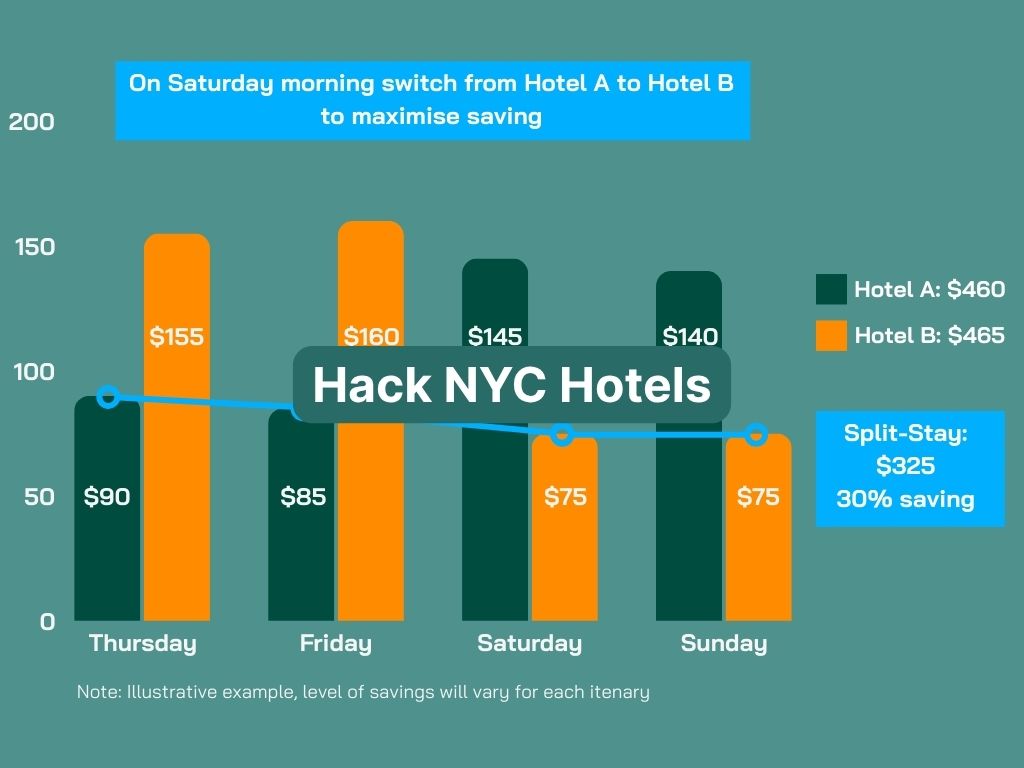
Hack NYC Hotels: Could Splitting Your Stay Unlock Serious Savings? 🔑🍃
Hack NYC Hotels: Could Splitting Your Stay Unlock Serious Savings? 🔑🍃
Picture this: you're planning a week in NYC, and hotel prices are making your wallet weep. One hotel quotes $200 Sunday through Wednesday, then jumps to $400 for the weekend. Another hotel offers weekend rates at $250, but charges $350 during the week. Sound familiar?
Editor’s note: Hotel Splitter is now live in London — planning a trip? Start with our London guides.
TL;DR: A split stay in New York means using two different hotels across your week so you can lean on cheaper nights at each one. Instead of paying one hotel’s highest weekend and peak rates you often combine weekday deals and calmer nights to keep the overall cost down without dropping quality.
And while New York City's dramatic price swings make it a perfect example, this savvy approach of splitting your stay can unlock value in many expensive cities worldwide where hotel rates are not always what they seem.
What if there was a way to grab the best of both worlds, and make the overall bill feel far more manageable? 💡
Welcome to the world of “split stays”, a clever travel hack that some NYC visitors use to work with the city’s unpredictable hotel pricing rather than against it. If you've been following our price puzzle post about why NYC hotel rates swing like a pendulum, you're ready to turn that knowledge into practical value.
The NYC Hotel Price Rollercoaster Recap 🎢
Before we dive into the solution, let's quickly revisit the problem. NYC hotel prices do not just fluctuate, they can feel like they are doing gymnastics. A hotel room that costs $180 on Tuesday might jump to $350 on Saturday. Convention schedules, seasonal demand, local events, and even weather shifts can send rates in different directions at different properties.
This is not just annoying, it is an opportunity. And that is where split stays come in.
What Exactly Is a “Split Stay”? 🏨🔄
A split stay is exactly what it sounds like: booking consecutive stays at two (or more) different accommodation properties within the same city during a single trip.
You might have even noticed major travel platforms like Airbnb using the term “Split Stays” for longer stays in apartments or rooms. It is a useful concept that highlights how travelers are looking for smarter ways to book. At Hotel Splitter, we are focused on how this idea of splitting your stay can be uniquely applied to hotels, especially in dynamic and expensive cities like New York, by using the way their nightly prices change.
Instead of committing to one hotel for your entire NYC adventure, you strategically divide your nights between different hotels. The goal is to use lower nightly rates when and where they appear by moving to whichever hotel offers the best deal for specific dates.
Think of it as hotel rate “arbitrage”, you are leaning on the fact that different hotels have different pricing patterns throughout the week.
The Core Logic: Timing Is Everything ⏰
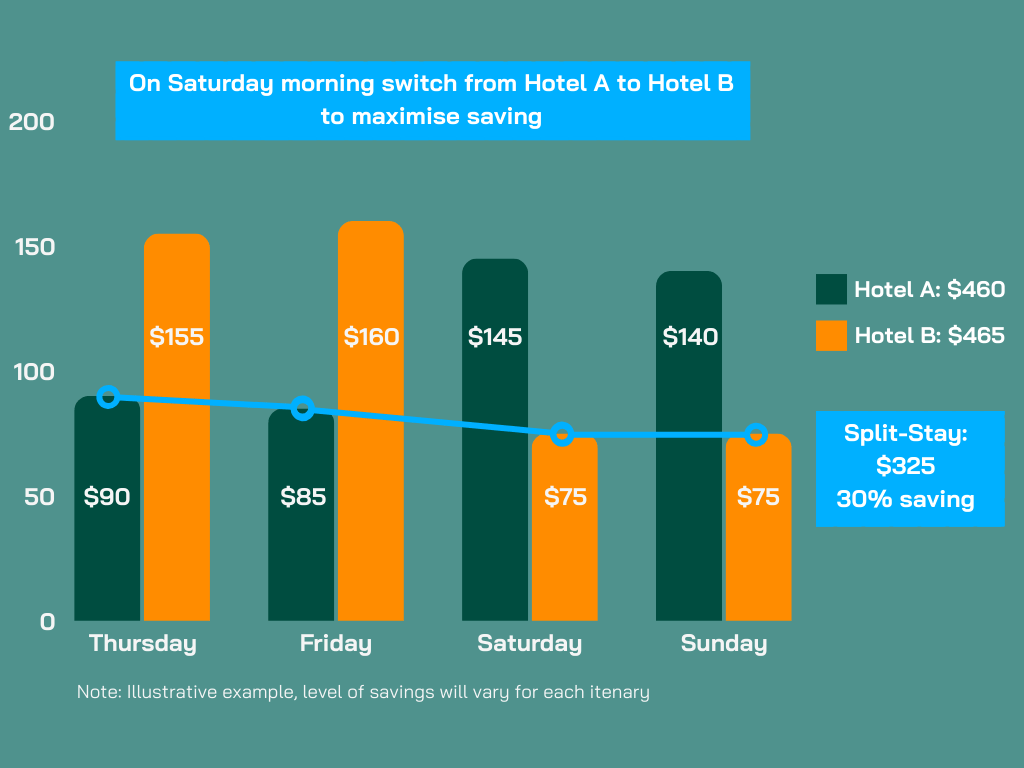
Here's the key idea: by choosing different hotels for different parts of your stay, you can avoid peak prices at one hotel by moving to another that is cheaper on those specific dates.
Remember that example from our price puzzle discussion? One hotel charging $180 midweek but $350 on Saturday, and another that stays relatively calm on weekends. A split stay lets you use those $180 nights at Hotel X, then switch to Hotel Y (which might have its better weekend deals) for the pricier part of your trip.
You are essentially using each hotel in its best value window.
Split Stay Examples: How the Numbers Can Work 📊
Here are two simple scenarios to show how this strategy plays out. The numbers are illustrative, but the pattern is very common in New York.
Scenario 1: The Weekend Warrior
The trip: 7 nights in NYC (Sunday arrival, Saturday departure)
Hotel A: Great weekday rates but weekend surge pricing
- Sunday to Wednesday: $160 per night (4 nights = $640)
- Thursday to Saturday: $320 per night (3 nights = $960)
- Total for 7 nights at Hotel A: $1,600
Hotel B: Higher weekday rates but more moderate weekends
- Sunday to Wednesday: $280 per night (4 nights = $1,120)
- Thursday to Saturday: $220 per night (3 nights = $660)
- Total for 7 nights at Hotel B: $1,780
The split stay pattern:
- Stay at Hotel A Sunday to Wednesday: $640
- Switch to Hotel B Thursday to Saturday: $660
- Split stay total in this example: $1,300
In this scenario the combined stay works out cheaper than either full week at Hotel A or Hotel B alone.
Scenario 2: The Neighborhood Explorer
The trip: 5 nights in NYC
Instead of spending $200 per night ($1,000 total) at a basic Midtown hotel for all 5 nights, consider this split:
- 3 nights in a well located Financial District hotel: $150 per night during weekdays ($450)
- 2 nights in a boutique Brooklyn hotel: $275 per night on weekends ($550)
- Split stay total: $1,000
Same overall spend in this example, but now you are experiencing two distinct NYC neighborhoods and potentially staying in properties you might not justify for every night of the trip.

Beyond the Money: The Unexpected Benefits 🎁
While the financial side is important, split stays also come with extra advantages that make the strategy even more attractive:
Neighborhood diversity: Experience different sides of NYC, perhaps the energy of Times Square for a few nights, then the charm of the Lower East Side or Brooklyn for the rest of your stay.
Hotel variety: Try different amenities, styles, and vibes. Maybe start with a business hotel’s excellent fitness center, then finish with a boutique property’s rooftop bar.
Flexibility: If your first hotel disappoints, your second choice becomes a fresh start rather than being committed for the entire trip.
“But Isn’t Moving Hotels a Hassle?” 🤔
Yes, split stays involve packing up and relocating mid trip. But here is how to frame it:
The trade off: A short transition for a potentially better overall price and a richer NYC experience.
Minimising the hassle:
- Pack strategically with easy to move luggage
- Choose hotels that are reasonably close or connected by simple subway routes
- Plan your switch during a natural break in your itinerary
- Use the move as an opportunity to explore a new neighborhood on foot
Many seasoned NYC travelers actually like this approach, it keeps the experience fresh and lets you optimise your location based on your daily plans.
This Is Smart Travel, Not Desperate Measures 🧠
Split stays are not about settling for less or complicating your trip. This is a sophisticated travel strategy used by visitors who understand how to work with the way hotels price rooms.
You are not just spending less, you are optimising your NYC experience. You are using knowledge that most tourists never tap into.
The Future of Smart NYC Hotel Booking 🚀
Manually researching and coordinating split stays takes time. You need to compare rates across multiple hotels, match pricing patterns, ensure availability aligns, and book everything separately. It is doable, but it is work.
That is exactly why tools that can automate this pattern are appealing for frequent city travelers.
Ready to Hack Your Next NYC Trip? 🔓
Interested in split stays but not in doing the heavy lifting yourself? Hotel Splitter is being built to analyse rate combinations and help surface smart split stay patterns automatically, so you can lean on the idea without needing a spreadsheet.
Want more NYC money saving context? Check out our guides on budget friendly neighborhoods, avoiding hidden hotel fees, and understanding NYC's hotel price patterns, plus the overview on what split stays are and how they work.