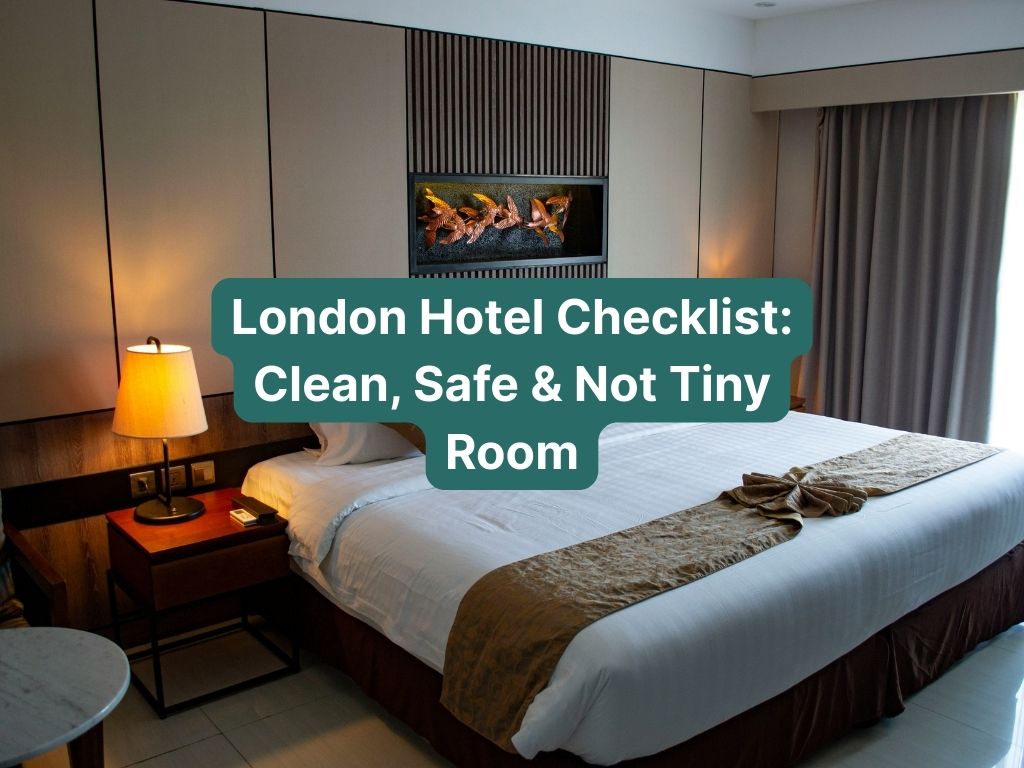
London Hotel Checklist: Clean, Safe & Not Tiny Room
You've narrowed down your London stay to a shortlist. But the worry creeps in: what if the room feels cramped? What if it's noisy, or too warm in summer, or the "deal" price isn't as clear as it looks? What if the reviews mention cleanliness problems or room security issues?
This is your practical checklist for sanity-checking any hotel listing before you click book. It covers the things that can make or break a 4–7 night stay: cleanliness, actual room size, heat comfort, noise, neighbourhood context, accessibility basics, and pricing tricks to watch for.
Hotel Splitter helps you plan a smarter London week — sometimes with one manageable midweek switch that can reduce the total cost or improve availability — but whether you're booking one hotel or two, this checklist applies to both.
Quick answer
- Check the total price, not just the nightly rate (and be sceptical of dramatic "deal" messaging).
- Scan recent reviews for repeat issues: cleanliness, noise, heat comfort and basic security.
- Reality-check room size using any listed m² plus guest photos and "can't open suitcase" type reviews.
- For warmer months, look for cooling/ventilation mentions in amenities and summer reviews.
- Use map context + reviews to predict noise (busy roads, nightlife, thin walls).
- Sanity-check location fit for your plans and Tube access (without labelling areas as safe/unsafe).
- If relevant, check accessibility basics (lifts, step-free stations and routes).
- Use star ratings as one signal — they don't guarantee room size or silence.
Related: our London trust guide. Check your dates to compare options for your week.
The 8 checks that prevent regret
1. Total price and deal wording
Check you're seeing the full cost before the final booking page. According to CMA guidance on online booking, prices should be clear and include mandatory fees. The ASA travel pricing rules also apply to discount claims and urgency messages.
How to check:
- Compare the headline nightly rate to the final total (look for mandatory taxes/fees or pay-at-hotel extras).
- Treat "only 2 rooms left" / countdown messaging as a prompt to double-check, not a reason to rush.
- Sanity-check the same dates on one other site to confirm you're comparing like-for-like totals.
- Watch for currency settings (some sites default to USD/EUR); check what you'll actually be charged in.
Why it matters for a London week: Over 5–7 nights, small differences in totals add up — and urgency prompts can nudge you into a booking you haven't properly checked.
2. Recent reviews and security signals
Read reviews from the past 3–6 months and look for mentions of security, door locks, staff responsiveness, and overall safety. The Metropolitan Police visitor safety advice recommends choosing accommodation carefully and checking reviews.
How to check:
- Filter reviews to "most recent" and scan for keywords: door locks, key cards, lobby security, staff presence at night.
- Look for patterns in negative reviews (one mention of noise is anecdotal; ten mentions suggest a real issue).
- Check if the hotel responds to reviews, especially negative ones — this shows management engagement.
- Cross-reference reviews across platforms (Google, Booking.com, another review site) to spot consistent themes.
Why it matters for a London week: You're storing luggage and returning late after theatre or dinner; working door locks and responsive staff help you feel secure throughout your stay.
3. Cleanliness signals in reviews
There isn't one official cleanliness score you can rely on, so reviews are your main signal. Look for recent mentions of bathroom condition, bedding freshness, carpet or surface stains, and pest issues.
How to check:
- Search reviews for "clean", "dirty", "stains", "mould", "bedbugs", "smell".
- Check if cleanliness complaints are recent (within 3 months) or older — management may have changed.
- Look at photos uploaded by guests, not just official hotel photos.
- A single "cleanliness" rating on booking sites can reflect patterns across many guest reviews.
Why it matters for a London week: You're spending 5–7 nights in the room; persistent grime or pests can ruin sleep and make the stay feel longer than it is.
4. "Not tiny" room reality check
London hotel rooms can be small. If room size matters to you, look for dimensions (square metres) in the listing, study the photos for spatial cues, and compare reviews.
How to check:
- If the listing includes m², note it — lower numbers usually feel more compact, especially with two people and luggage.
- Look at guest photos showing the full room, not just styled corners — can you see floor space around the bed?
- Read reviews mentioning "cramped", "spacious", "can't open suitcase", "plenty of room".
- Check the bed configuration: larger beds can reduce usable floor space in compact rooms.
Why it matters for a London week: Over several nights, a room where you can't fully unpack or move around comfortably feels more frustrating than it would for a single overnight.
5. Heat comfort, air conditioning and ventilation
Some London hotels have air conditioning, others don't. If you're visiting in warmer months, it's worth double-checking cooling and ventilation. The NHS heatwave guidance explains why keeping indoor spaces cool matters during hot spells — that's general health advice, not a hotel standard.
How to check:
- Look for "air conditioning", "climate control", or "AC" in the listing amenities.
- If AC isn't listed, check for "fan", "opening windows", or "well-ventilated" in the description or reviews.
- Read summer reviews (July–August) for mentions of heat, stuffiness, or comfort.
- Top-floor or south-facing rooms can be warmer; some hotels let you request a cooler room orientation.
Why it matters for a London week: A sweaty, sleepless night is tolerable once; five nights in a stuffy room can leave you exhausted and irritable.
6. Noise and sleep quality
Location, room position, and building design all affect noise levels. Reviews and map context can help you gauge what to expect.
How to check:
- Search reviews for "noisy", "quiet", "street noise", "thin walls", "traffic", "sirens".
- Use Google Maps street view to see if the hotel faces a busy main road, night bus route, or late-night venue.
- Check if the listing mentions soundproofing, double glazing, or quiet floors.
- When booking, you may request a room away from lifts, ice machines, or the street if you're a light sleeper.
Why it matters for a London week: Central London is lively; cumulative sleep disruption over several nights can affect your energy and mood.
7. Location sanity check
Rather than labelling areas as "safe" or "unsafe", check how the location fits your plans: proximity to what you want to do, Tube access, and walkability. Our where to stay guide covers neighbourhood contexts in detail.
How to check:
- Map the hotel against your planned activities (museums, theatre, meetings, restaurants) to see if it's genuinely convenient.
- Check walking time to the nearest Tube or train station (Google Maps walking directions are often more reliable than "5-minute walk" claims).
- Read reviews mentioning the street feel at night (lighting, late-night noise, general comfort walking back).
- Avoid making assumptions based on postcode or area name alone; London neighbourhoods vary street by street.
Why it matters for a London week: A hotel that's "near" your plans but requires two Tube changes each way becomes tedious over multiple days.
8. Accessibility basics (if relevant)
If you or anyone in your group has mobility needs, check step-free access at both the hotel and your transport links. TfL's accessibility hub and step-free station guidance are essential planning tools.
How to check:
- Check whether the hotel has a lift (not all London buildings do, especially older or budget properties).
- Ask if accessible rooms are on the ground floor or require lift access.
- Check if your nearest Tube station is step-free using TfL's maps (many central stations are not).
- Read reviews from guests mentioning wheelchairs, mobility aids, or accessibility experiences.
Note: step-free access can change day-to-day if lifts are out of service, so it's worth having a backup route.
Why it matters for a London week: Navigating stairs with luggage or mobility aids becomes exhausting quickly; planning step-free routes in advance saves stress.
What star ratings do and don't tell you
Hotel star ratings in the UK — assessed through schemes like VisitBritain's quality assessment — reflect service level, facilities, and overall quality. But they don't guarantee room size, specific features like air conditioning, or silence. A 4-star hotel can have small rooms if the fixtures and service are high-quality, and a lower-star hotel may be quieter than a higher-star one on a busy road. Use star ratings as one signal among many, not a checklist substitute.
Frequently asked questions
How do I tell if a London hotel room is tiny?
If the listing shows m², lower numbers tend to feel more compact — especially with two people and luggage. Study guest photos showing the full room layout, not just styled corners. Read reviews mentioning "cramped", "can't open suitcase", or "spacious" to get a sense of real-world experience. Some hotels list room categories like "compact double" or "standard double", which can signal size differences.
Do London hotels have air conditioning?
Not all of them. Many newer or business-focused hotels include AC, but older buildings and budget properties may rely on fans or opening windows. Check the amenities list for "air conditioning" or "climate control". If you're visiting in summer, read July or August reviews to see if guests mentioned heat or comfort issues.
How do I avoid a noisy room?
Search reviews for noise-related keywords ("traffic", "thin walls", "sirens"). Use Google Maps street view to check if the hotel faces a main road or busy junction. When booking, request a room away from the street, lifts, or ice machines. Hotels can't guarantee silence in central London, but room position and building design make a difference.
Is it safe to use public transport at night in London?
London's public transport is generally safe, and TfL's safer travel at night guidance recommends using licensed options. Night services run on some routes at weekends. Licensed black cabs and minicabs booked in advance are regulated; unbooked minicabs are illegal and uninsured. Plan your route in advance and stay aware of your surroundings.
What does "near a Tube station" really mean?
It varies. Some hotels say "5-minute walk" when it's actually 10–15 minutes with luggage or in rain. Use Google Maps walking directions to check the actual distance and route. A hotel 200 metres from a station but up a steep hill can feel less convenient than one 400 metres away on flat ground. Read reviews mentioning transport access to get a realistic picture.
Can I trust urgency messages like "only 2 rooms left"?
Not always. Treat urgency prompts as a cue to slow down and double-check what you're actually buying (room type, policy and total price). The CMA's guidance on online booking says availability and urgency claims should be accurate. If you're unsure, compare the same dates on one other site and make sure the totals and policies match.
Should I book one hotel or split my stay?
It depends on your priorities. One hotel is simpler if you value convenience and hate packing twice. Splitting your stay — say, 3 nights in one place and 4 in another — can sometimes unlock better value or let you experience two neighbourhoods, especially if you're staying 5+ nights. Hotel Splitter helps you explore both options; see how it works for a step-by-step guide. Sometimes one hotel really is the best choice, and that's fine too.
If you're considering a split stay, our London logistics guide explains how to make the switch day feel manageable.
Related guides
- London trust guide (how to choose well-reviewed stays)
- Where to stay in London (base choice without overpaying)
- How Hotel Splitter works (step-by-step)
- Is Hotel Splitter legit? (how the booking works)
Sources we used
- CMA guidance on online booking services (pricing and urgency principles)
- ASA travel marketing and pricing advice
- Metropolitan Police visitor safety guidance
- TfL safer travel at night
- TfL transport accessibility hub and step-free station guidance
- VisitBritain quality assessment scheme
- NHS heatwave guidance (general health context)
Book with confidence
No checklist eliminates every risk, but checking these eight basics — total price, recent reviews, cleanliness signals, realistic room size, cooling options, noise cues, location fit, and accessibility — helps you book calmly and avoid the regrets that linger over a week-long stay. For more on choosing well-reviewed London hotels, see our trust guide. To understand how splitting a stay can sometimes offer better value or flexibility, read how Hotel Splitter works and explore whether the approach is right for your trip.
Find your smarter week — Check your dates and see what's possible for your London stay.
Last updated: 3 February 2026