.jpg)
Why Are New York Hotels So Expensive Right Now, Average Prices and What To Do
If you've ever spent hours scrolling through pages of eye-watering New York hotel prices, you're probably familiar with that sinking feeling of sticker shock. Seeing nightly rates pushing $300, $400, or even higher can make you wonder whether the trip is still worth it.
The good news is that expensive does not always mean uniformly expensive. In New York, the whole stay is not always overpriced in the same way. One or two nights can do most of the damage, especially around weekends, event dates, and neighbourhood-specific spikes.
That is what makes this question useful. Once you understand why New York hotels are expensive, you can stop treating the trip as one lump sum and start looking for the part of the week that is distorting the total.
TL;DR: New York hotels are expensive because demand stays high, space is limited, operating costs are high, and peak dates distort pricing. The useful thing to know is that the week is not always broken evenly. Sometimes one or two nights are driving most of the total. That is when adjusting dates, changing area, or comparing one hotel with a split stay, 2 hotels in one trip, can make the numbers more workable.
Why Are NYC Hotels So Expensive?
Before getting into what to do about it, here are the main reasons prices often feel painfully high:
- Constant high demand, NYC is both a tourist magnet and a global business hub with year-round events, so millions of visitors compete for limited rooms.
- Limited geographic space, especially in Manhattan, scarce space drives property costs up, which flows through to room rates.
- High operating costs, labour, taxes, utilities and maintenance are expensive in New York, raising hotel prices.
- Seasonality and peak dates, weekends, holidays, Broadway openings, Fashion Week and big conferences can all push rates higher.
- Premium location factor, prime areas like Midtown, SoHo and Times Square command consistently higher prices.
Knowing these factors does not instantly cut the cost, but it helps you diagnose whether you are dealing with a generally expensive trip or a week where one part of the stay is doing most of the damage.

The part many travellers miss, the week is not always expensive in the same way
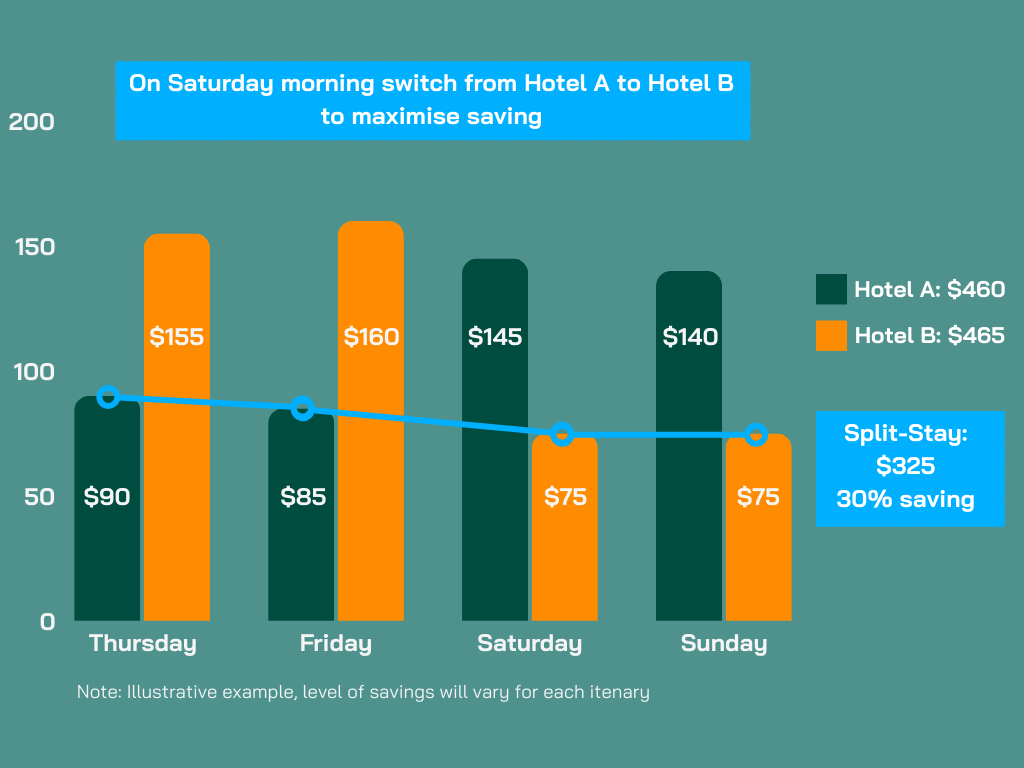
Hotel prices in NYC do not just move by season. The same hotel can be materially more expensive on one or two nights because of weekend demand, event dates, or a local surge in a specific area.
For example, a room that feels acceptable on Monday can look out of proportion on Friday or Saturday. Or a hotel near one popular area can spike while another part of the city stays calmer.
That is why it helps to compare the trip night by night, not just by full-stay total. Sometimes the best answer is still one hotel. Sometimes it starts by avoiding the worst night or splitting the stay across two hotels.
That approach is usually called a split stay, 2 hotels in one trip. It is not for every trip, but it is worth checking when one part of the week is doing most of the damage.
How budget travellers cope with New York's high hotel costs
Once you know the week may not be broken evenly, the next step is to test the levers that actually change the total.
1. Change the shape of the stay before you downgrade the whole trip
If the total looks wrong, first test the structure of the week rather than immediately giving up on location or comfort.
- Shift the trip by a day or two and compare again.
- Check whether one Friday or Saturday is distorting the total.
- Compare one hotel with a split stay if one night looks wildly out of line.
- Look at whether one neighbourhood is inflating the budget more than the others.
This is often a better first move than accepting a much worse hotel for the entire trip.
2. Stay further out and commute in
A straightforward solution is to stay outside central Manhattan. Popular areas for value-minded travellers include:
- Long Island City
- Astoria
- Williamsburg
- Bushwick
- Jersey City
These areas can offer lower nightly rates. You give up a little convenience, but NYC's public transport can keep the trade-off manageable.
Pros: more scope for savings, more local feel.
Cons: extra travel time, less central.
For more detail on which areas suit different types of trips, see our guide to NYC neighbourhoods for solo travellers.
3. Choose lower cost accommodation types when the trip allows
Hotels are not your only option. Depending on the trip, you could also compare:
- Hostels, useful for solo travellers chasing affordability and social energy.
- Pod and micro-hotels, smaller rooms in prime spots at lower prices.
- Budget chain hotels, basic but more predictable on price.
Pros: lower costs, more options in strong locations.
Cons: smaller rooms, less privacy, fewer extras.
4. Book and compare intelligently
Timing and comparison discipline still matter:
- Book early, reserving further ahead can often give you better options.
- Look at off-season windows, January and February can bring softer pricing.
- Compare like for like, same dates, similar location, similar room standard.
- Use price alerts and comparison sites, so you notice when the pattern changes.
If you want a deeper look at how prices move by day and week, our guide to dynamic hotel pricing breaks down the patterns.
5. Offset the trip with free NYC activities
Free attractions like Central Park, the High Line, and museum free-entry days can help ease the overall trip budget, even if they do not change the room rate itself.
When a split stay is most worth checking
A split stay is not the answer to every expensive week. It is most worth checking when:
- one Friday or Saturday night looks wildly higher than the rest of the stay
- you are staying 5 nights or more, so one bad night has room to distort the total
- one area is expensive on some nights but not all
- you want to protect location and comfort, rather than solving the problem by moving far out for the full trip
If that sounds like your week, the next useful read is our guide to the split stay hotel hack in NYC, which shows the logic in more detail.
Where Hotel Splitter fits
Hotel Splitter was built around this exact kind of problem, where a full-stay total hides one or two disproportionately expensive nights.
Hotel Splitter is currently live in London, where it helps travellers compare one hotel with split stay packages on the same dates and see one total price before they book.
If you are planning London, start with our London split stay guide or go straight to Hotel Splitter to compare dates.
If you are planning New York, use this page and the linked NYC guides to spot whether price variance, not the whole city, is what is making your trip feel overpriced.
Your NYC trip does not have to be uniformly expensive
New York can absolutely be pricey, but the useful question is not just why the city is expensive. It is whether your exact week is expensive from start to finish, or whether one or two nights are creating most of the pain.
When one part of the stay is doing most of the damage, you usually have more options than you think.
- See the NYC split stay hotel hack in more detail
- Understand how hotel prices change day to day
- Compare areas that can give better value
Planning London instead? Start with our London split stay guide.
Last updated: April 2026.