.jpg)
Where to stay in London: find your best base
London does not have one centre. It has clusters. Choosing where to stay gets stuck because there are too many good options.
If you are feeling overwhelmed, the quickest way out is to stop trying to find the “best area” and instead get to a shortlist based on a few practical trade-offs.
Take the London Base Finder quiz
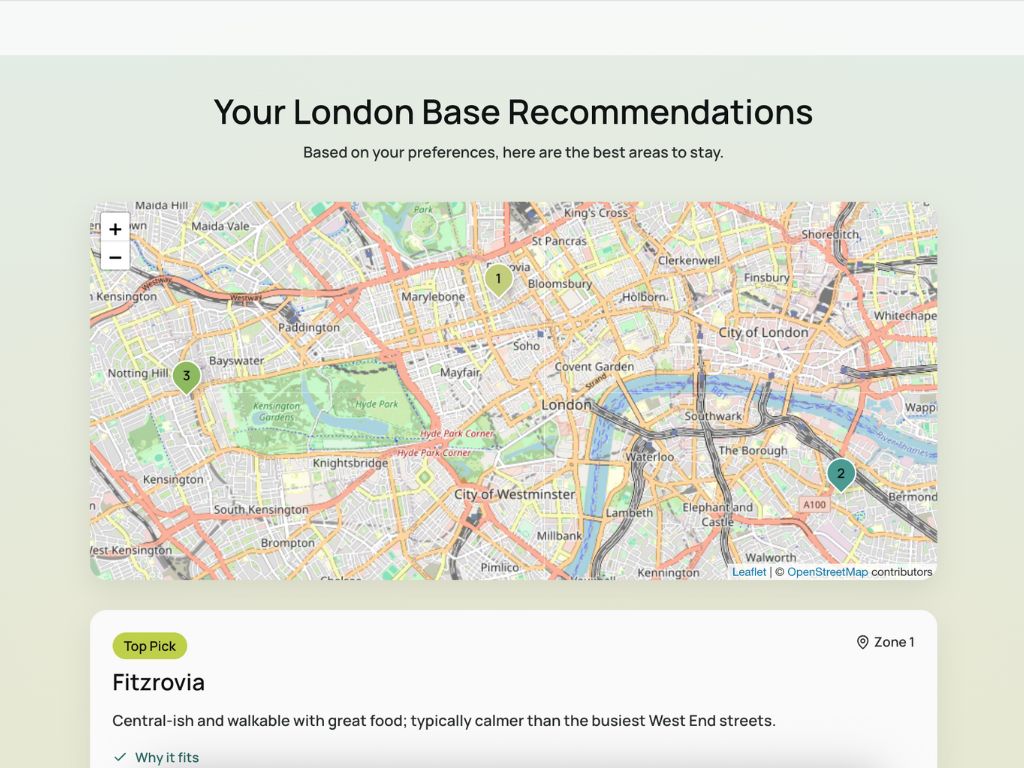
- Top 3 London base areas (single-base options).
- One optional two-base plan (a simple one-switch pairing).
- A copyable share link that recreates the same shortlist.
The Hotel Splitter team built London Base Finder to reduce choice overload for London trips. It turns a few practical trade-offs into a shortlist you can act on.
Use the shortlist as a starting point, then let your dates and totals decide the final pick.
If you prefer to read first and decide second, start with London hotel guides: start here, then come back to the quiz when you want a shortlist.
How to choose where to stay in London without overthinking
Most “where to stay in London” content assumes you want a neighbourhood list. That often creates more browsing, not more clarity.
A calmer approach is to make one clear trade-off first, then use it to narrow your options. London Base Finder is designed for the stuck moment. It helps you choose a base by fit and practicality, then gives you a clear next step: check your dates and totals and move on.
How London Base Finder works
We built the tool to make the decision consistent. The same criteria are applied across a defined set of London base areas, then your answers choose the trade-off.
At a high level, each base area is assessed across 12 practical criteria. They cover the things that usually create friction when you base yourself in London, including:
- How central the base feels in practice and how easy it is to get around.
- How walkable the area is day-to-day.
- What evenings tend to feel like locally, and whether there is much happening after dark.
- Everyday convenience like food and coffee nearby.
- Access to culture, parks and other day-out anchors.
- Typical price pressure for a comfortable stay, and how easy arrival and departure can feel via major hubs and common rail links.
The output is not a “best area” claim. It is a short list of “good fit for” options, plus one optional one-switch plan when a two-base rhythm fits better than forcing one base to do everything.
How to interpret your results
Your shortlist is driven by 7 questions. They are designed to force a clear trade-off, then turn that trade-off into something you can actually compare.
- How central do you want your base to feel?
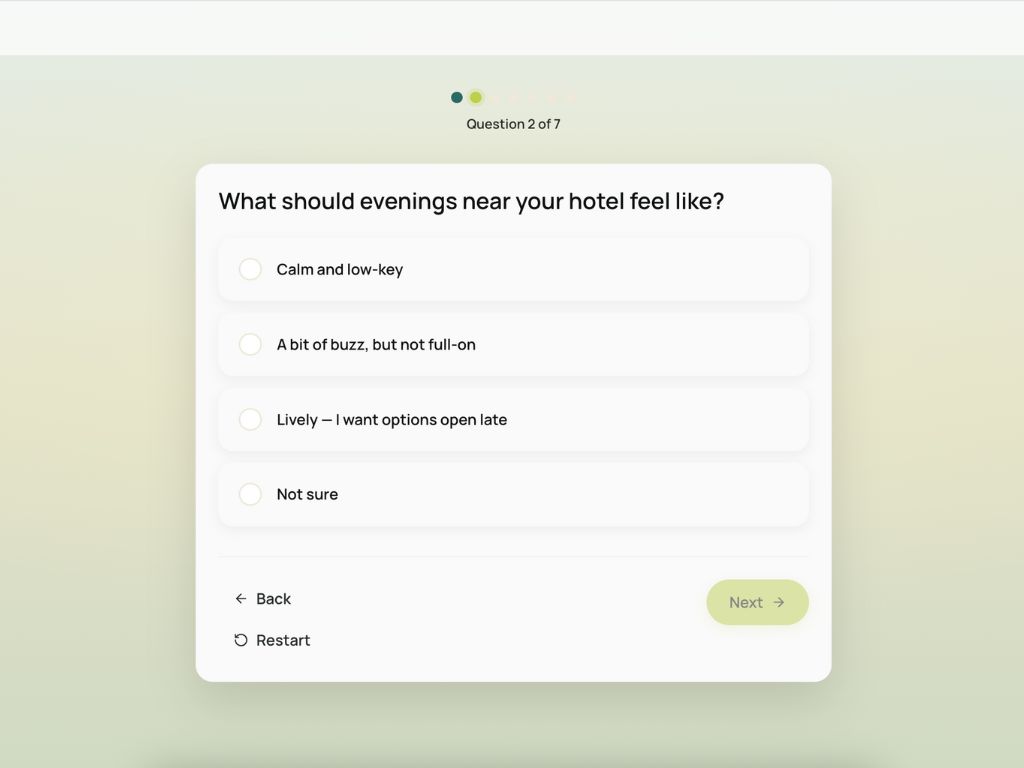
- What should evenings near your hotel feel like?
- How do you want to get around most days?
- If you could have one thing on your doorstep, what would it be?
- How much does night-time noise bother you?
- How important is an easy arrival and departure?
- Would you consider one simple mid-trip hotel switch?
To sanity-check the shortlist, use a simple 3-layer method:
- Anchor plans: what you care about doing most.
- Transport tolerance: walk-first, Tube-first, or one line most of the time.
- Doorstep priorities: quiet versus lively, parks versus food, and easy arrival versus maximum centrality.
If you want a quick summary you can remember, these rules of thumb do most of the work:
- London does not have one centre. It has clusters.
- Pick one trade-off: faster central access or a calmer base.
- Optimise for one line most of the time, plus one useful interchange.
- Treat noise tolerance as a filter, not an afterthought.
- If you are torn, one easy switch beats endless browsing.
- Use zones as a practical frame, not a neighbourhood ranking.
- Compare totals, not teaser prices.
What to do next if you want a fast decision
-
Take the quiz and save the shortlist: London Base Finder. Your first goal is not the perfect area. It is a short list you can compare.
-
Pick the trade-off you actually want: quicker central access, or a calmer base that still stays practical by transport.
-
Use zones as a quick reality check, not a ranking. As stated by Visit London (Accessed Jan 2026), London’s public transport has 9 travel zones, where Zone 1 covers central London and Zones 6 to 9 are the outskirts. London travel zones
-
Decide whether an easy one-switch plan is acceptable. If your results include one, treat it as a purposeful option when one base forces awkward compromises.
-
Check your dates and totals, then stop iterating. If your first choice is tight, use the fallback approach below rather than restarting from scratch.
One hotel or one change in London
One base is usually the default. However a split stay plan with one easy switch is a strong option when your priorities pull in two directions, or when availability forces compromises you do not want.
- Use one base if you want to unpack once and keep the trip simple.
- Use one easy switch if you want a smoother rhythm across the trip, with two different “fits” but only one move.
If you want the one-switch idea explained in plain steps, start with Split stays in London: how one change works.
If you want real split stay planning examples you can copy, use Where to stay in London for a week. If you are deciding between staying put and switching once, use One hotel or two in London?.
Where to drop bags on switch day
There are 3 good options. Pick the one that fits your plans, then enjoy the day hands-free.
- Go straight to hotel 2 (early bag drop). Best when your midday plans are in, or beyond, the second base. You avoid back-tracking and finish the afternoon near your evening base.
- Store at hotel 1, move later. Ideal if your lunch or afternoon is still closer to base 1. Leave bags with reception, enjoy your plans, then travel mid-afternoon to check in.
- Use station left luggage in the middle. Helpful if you are crossing town with multiple stops and want to stay light. As stated by Visit London (Accessed Jan 2026), left luggage facilities are available at London’s main train stations and Victoria Coach Station, and listed main train station locations are open daily from 07:00 to 23:00. Left luggage at stations
Rule of thumb: finish the day near hotel 2, drop at hotel 2 first. Spend most of the day near hotel 1, store at hotel 1. Crossing town with multiple stops, consider station left luggage.
If you want switch-day mechanics, use Logistics: switching hotels and luggage.
Two sanity checks before you commit
Transport costs and friction
Fare timing can affect how “near central” feels in practice. As stated by TfL (Accessed Jan 2026), peak fares apply Mon to Fri (not public holidays) 06:30 to 09:30 and 16:00 to 19:00, based on the time you touch in. TfL peak times
If you are choosing between two bases, make the connection type explicit. As stated by TfL (Jun 2024), the London Overground map key distinguishes interchange within station(s) from an under 10 minute walk via street between stations. Interchange versus walk connection
Keep pay as you go consistent. As stated by TfL (Accessed Jan 2026), you must touch in and touch out to pay the right fare, and you should use the same card or device each time you touch in and out. Pay as you go rules
Total price comparisons
When you compare options, compare totals that include compulsory charges, not teaser prices. As stated by the CMA (Accessed Jan 2026), displayed prices should include compulsory, reasonably calculable charges because consumers cannot avoid them. Total price including compulsory charges
If you want the broader guide set, use London hotel guides: start here.
If your first choice is unavailable (fallback approach)
Do not restart from scratch. Use a calm fallback order: widen your zones by one band, switch to a parallel line, then pick an interchange that reduces changes to your anchor plans.
As stated by the CMA (Accessed Jan 2026), booking sites should not use false or misleading popularity or availability messages and should “tell the whole story” when making availability statements. Avoid misleading scarcity messages
FAQs
What does “base” mean here?
Your base is the part of London you return to and spend time in between plans. It shapes your mornings and evenings: what is on your doorstep for coffee and food, how walkable the area feels, and how simple it is to get around.
If you do a one-switch plan, you are choosing two bases on purpose, so you can enjoy two different London vibes.
Do I need to stay in Zone 1 to feel central?
Not necessarily. Zones are a practical frame, not a ranking. As stated by Visit London (Accessed Jan 2026), London’s public transport has 9 travel zones and Zone 1 covers central London. London travel zones
A base outside Zone 1 can still feel near central if your typical journeys stay predictable and you are not constantly changing lines.
How do I avoid paying more than needed on pay as you go?
As stated by TfL (Accessed Jan 2026), you must touch in and touch out to pay the right fare, and you should use the same card or device each time you touch in and out. Pay as you go rules
Do I have to do a split stay?
No. One base is often a good choice.
The one-switch option is there when it improves the week, for example if you want two different vibes, if one place is unavailable for part of the stay, or if a single base forces awkward compromises. For the decision in plain terms, use One hotel or two in London?.
Can a one-switch plan help with price and availability?
It can. Hotel pricing and availability move night by night, so one easy switch can sometimes avoid paying peak pricing across nights that do not need to be peak, or help when one place is sold out for one or two nights.
If you want the one-switch idea explained in plain steps, start with Split stays in London: how one change works.
Is a one-switch plan realistic?
It can be, if you keep it to one planned move and plan bags first. As stated by Visit London (Accessed Jan 2026), you can ask your accommodation if it can store your luggage while you enjoy the sights. Ask accommodation to store luggage
How do I compare hotel prices fairly?
Compare like-for-like totals and include compulsory charges. As stated by the CMA (Accessed Jan 2026), displayed prices should include compulsory, reasonably calculable charges because consumers cannot avoid them. Total price including compulsory charges
Try the London Base Finder then check your dates
Start with London Base Finder to get your shortlist, then check your dates to see what is available and what the total comes to.
Next reads
- London hotel guides: start here
- Split stays in London: how one change works
- Where to stay in London for a week
- One hotel or two in London?
- Logistics: switching hotels and luggage
Last updated: 22 Jan 2026